From tech security flaws and AI ethics to social media's impact and digital transformation, the global tech landscape faces innovation, regulation, and societal challenges.
Episode Description

Password Managers Share a Hidden Weakness Wired reported on February 21, 2026, that a new study from ETH Zurich and USI Lugano uncovered significant security flaws in prominent "zero knowledge" password managers like Bitwarden, Dashlane, and LastPass. Researchers found they could often access users' credentials, sometimes even their entire password vaults, especially when features like key escrow for backup and recovery were enabled. The findings challenge the "zero knowledge" claims made by these companies and highlight a perceived lack of scrutiny, as many of the vulnerabilities discovered were relatively simple to exploit. This suggests a potential hidden weakness across the industry. Source

Why Olympic Choreographer Benoît Richaud Went Viral Just for Changing Jackets Wired reported on February 18, 2026, that Olympic figure skating choreographer Benoît Richaud went viral at the 2026 Winter Games for frequently changing jackets. Richaud coaches 16 skaters from 13 different countries and adopts each team's jacket while sitting with them at the "kiss and cry" area. His stoic demeanor amidst the constant costume changes drew widespread attention. Richaud uses technology to manage choreography updates for his numerous athletes and hopes his newfound fame will bring more public interest and appreciation to the sport of figure skating. Source

Donald Trump Jr’s Private DC Club Has Mysterious Ties to an Ex-Cop With a Controversial Past Wired reported on February 19, 2026, that Donald Trump Jr.'s private DC club, "The Executive Branch," has unexpected ties to Sean LoJacono, a former Metropolitan Police Department officer with a controversial past. Corporate filings reveal LoJacono as a "beneficial owner" and Director of Security for the club, despite not being a publicly known founder. LoJacono previously gained notoriety for a 2017 stop-and-frisk incident that led to a civil rights lawsuit and his near-dismissal from the police force. His involvement raises questions, especially as other reported co-owners like Trump Jr. are not listed on the same incorporation documents. Source
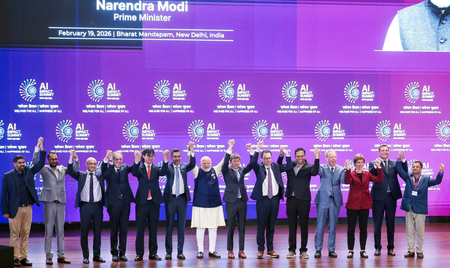
'AI Impact Summit sees India emerging as key player on global stage' Lokmat Times reported on February 22, 2026, that the AI Impact Summit in New Delhi positioned India as a key global player in the evolving AI landscape. The nation is prioritizing inclusivity as it navigates the technological era, drawing lessons from past adoptions like computerization in the 1980s. AI is seen as a tool for educational equity, capable of bridging gaps for remote students and overcoming language barriers. While it can empower teachers by reducing administrative tasks, the human element remains vital. Challenges include the digital divide and privacy concerns, emphasizing the need for robust infrastructure and policy to ensure widespread benefit. Source
"You can never become completely digital; Human element is needed to reach the masses": New India Assurance CMD Girija Subramanian The Tribune reported on February 22, 2026, that Girija Subramanian, CMD of New India Assurance, emphasized the necessity of a human element alongside digital transformation to effectively reach the masses in India. Speaking at the 25th Global Conference of Actuaries, Subramanian stated that while digital services suit urban, educated customers, a "human value chain" is crucial for selling insurance products in Tier 2, Tier 3 cities, and rural areas. This hybrid strategy aims to achieve "Insurance for All" by 2047, by educating young people about insurance and adhering to "Nat Cat" (Natural Catastrophe) rates for financial stability. Source

The next iTunes may be vibe-coded The Verge reported on February 19, 2026, about Parachord, a "vibe-coded" music app being developed by music tech veteran J Herskowitz. Built with AI assistance (Claude Code) and as a spiritual successor to his 2011 open-source project Tomahawk, Parachord aims to liberate music metadata from streaming service silos. It seeks to enable universal music sharing, social connections between music fans, and highly personalized recommendations. Designed for a niche audience of dedicated music enthusiasts, the app leverages personal API keys for integrations, making it a passion project focused on user control without the need for traditional business models. Source

The War Over Prediction Markets Is Just Getting Started Wired reported on February 20, 2026, that a fierce political battle is escalating in the US regarding prediction markets like Polymarket and Kalshi. The conflict sees an unusual alignment of conservative Mormons and Las Vegas interests against these platforms, arguing they constitute illegal, unregulated gambling. Conversely, some MAGA figures and liberal lobbyists defend them as legitimate financial instruments offering valuable forecasting. Kalshi, which reported over $1.3 billion in trades on Super Bowl Sunday, is currently facing 19 lawsuits, highlighting the complex and growing scrutiny from both state regulators and federal lawmakers. Source

Your next laptop could be a foldable phone The Verge reported on February 17, 2026, that its podcast, The Vergecast, discussed the increasing potential for foldable phones to serve as laptops. With advancements in foldable screen technology, the previous limitations of small screens and keyboards are diminishing. The episode also featured Sportico's Jacob Feldman, who delved into the evolving landscape of sports streaming, highlighting the use of drones in Winter Olympics coverage and YouTube's expanding influence in both television and sports. The conversation concluded that while foldables theoretically offer the versatility of two devices, software integration still poses a challenge. Source

Leading US Research Lab Appears to Be Squeezing Out Foreign Scientists Wired reported on February 20, 2026, that NIST, a leading US research lab, appears to be implementing new measures restricting foreign scientists, potentially costing the country valuable expertise. Democratic lawmakers, including Zoe Lofgren, expressed concern over rumored changes, such as limiting international graduate students and postdocs to three years. These policies, reportedly driven by the Trump administration and Department of Commerce, have already led to cancellations of foreign worker programs. While NIST cited protecting US science from theft, critics argue the restrictions are excessive, demanding transparency and a pause until Congress can assess their necessity. Source

Big Tech Says Generative AI Will Save the Planet. It Doesn't Offer Much Proof Wired reported on February 18, 2026, that energy researcher Ketan Joshi questioned Big Tech's claims about generative AI's ability to save the planet. Google, for instance, stated AI could cut global greenhouse gas emissions by 5-10% by 2030, a figure Joshi traced to a "flimsy" BCG analysis based solely on client experience. Despite its own sustainability report acknowledging that AI build-out was increasing its corporate emissions, Google continued promoting this statistic. The rapid development of energy-intensive AI infrastructure is significantly driving up energy demands, raising concerns about its actual environmental impact versus the unproven benefits touted by tech executives. Source

The Google Pixel 10a Is Barely Different From the Pixel 9a Wired reported on February 18, 2026, that the new Google Pixel 10a shows minimal differences from its predecessor, the Pixel 9a, a departure from Google's usual A-series upgrades. The 10a retains the older Tensor G4 chipset instead of the anticipated G5 and features only minor aesthetic changes, such as a slightly thinner screen bezel and a flush rear camera. Google attributed the lack of significant advancements to "trade-offs to maintain the $499 price," possibly due to rising memory costs. Despite these modest changes, the Pixel 10a is still expected to be a competitive option in the sub-$500 smartphone market. Source

Social media on trial: tech giants face lawsuits over addiction, safety, and mental health The Verge reported on February 18, 2026, that major social media companies, including Meta, Snap, TikTok, and Google-owned YouTube, are facing bellwether lawsuits regarding their platforms' impact on teens' safety and mental health. These cases allege that the platforms' designs contribute to addiction, depression, and anxiety. Notably, these lawsuits have overcome initial attempts to dismiss them under Section 230, which typically shields online platforms from liability for user content. Executives, including Meta CEO Mark Zuckerberg, are expected to testify, addressing questions about their efforts to protect young users. Source